Tessera Viz
PX-02
Financial crime and AML
See the money move.
An analyst looking at a suspicious transaction needs three things at once: who is connected to whom, when it happened, and where. Today that is usually three tools and a spreadsheet, and the work of holding them together is the analyst's.
What an investigation actually needs.
What the analyst gets
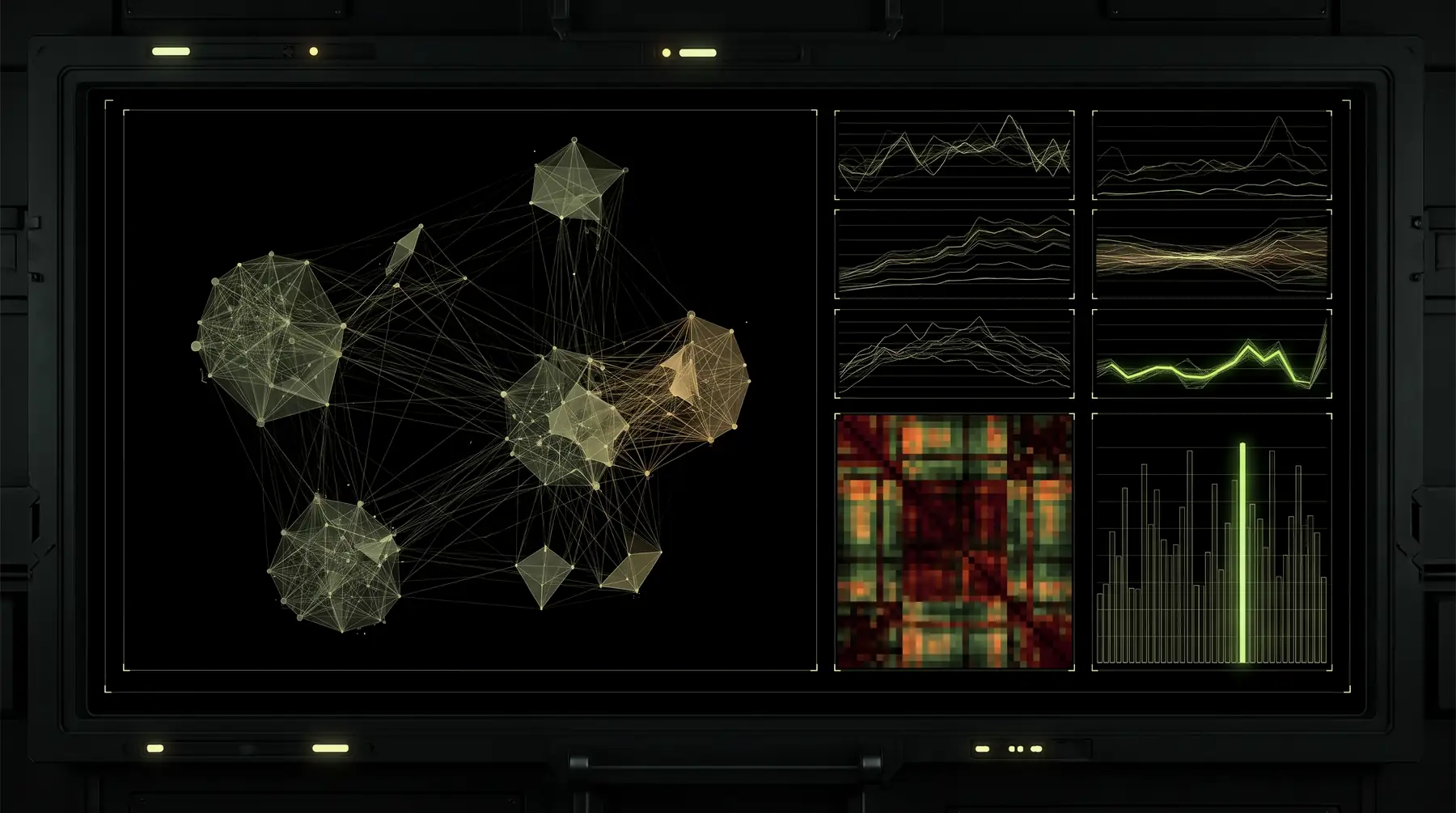
The account network as a graph, the transaction sequence as a timeline, counterparty geography as a map and the underlying rows as a grid — all one selection. Click an account and the timeline shows its transfers, the map shows its counterparties, the grid scrolls to its rows.
Community detection
Surfaces structuring rings: the cluster of accounts that move money between themselves more than they move it anywhere else. It is the shape the technique leaves behind, and it is visible before anyone writes a rule for it.
Betweenness
Finds the intermediaries. The account that sits on the path between two clusters is the one worth a subpoena, and centrality ranks it without anyone guessing.
Min-cut
Finds the chokepoint in a layering chain — the smallest set of transfers whose removal disconnects the source from the destination.
Tweak layout
Re-runs the layout while keeping existing positions stable, so a live feed does not scramble the analyst's mental map every time it arrives. An investigation is hours long; the picture has to survive it.
The compliance angle
Deploys air-gapped. No telemetry and no phone-home. An SBOM is provided, and the licence is verified locally with a signature rather than a call to us.