Tessera Viz
PX-02
By discipline
Who is connected to whom, when it happened, and where.
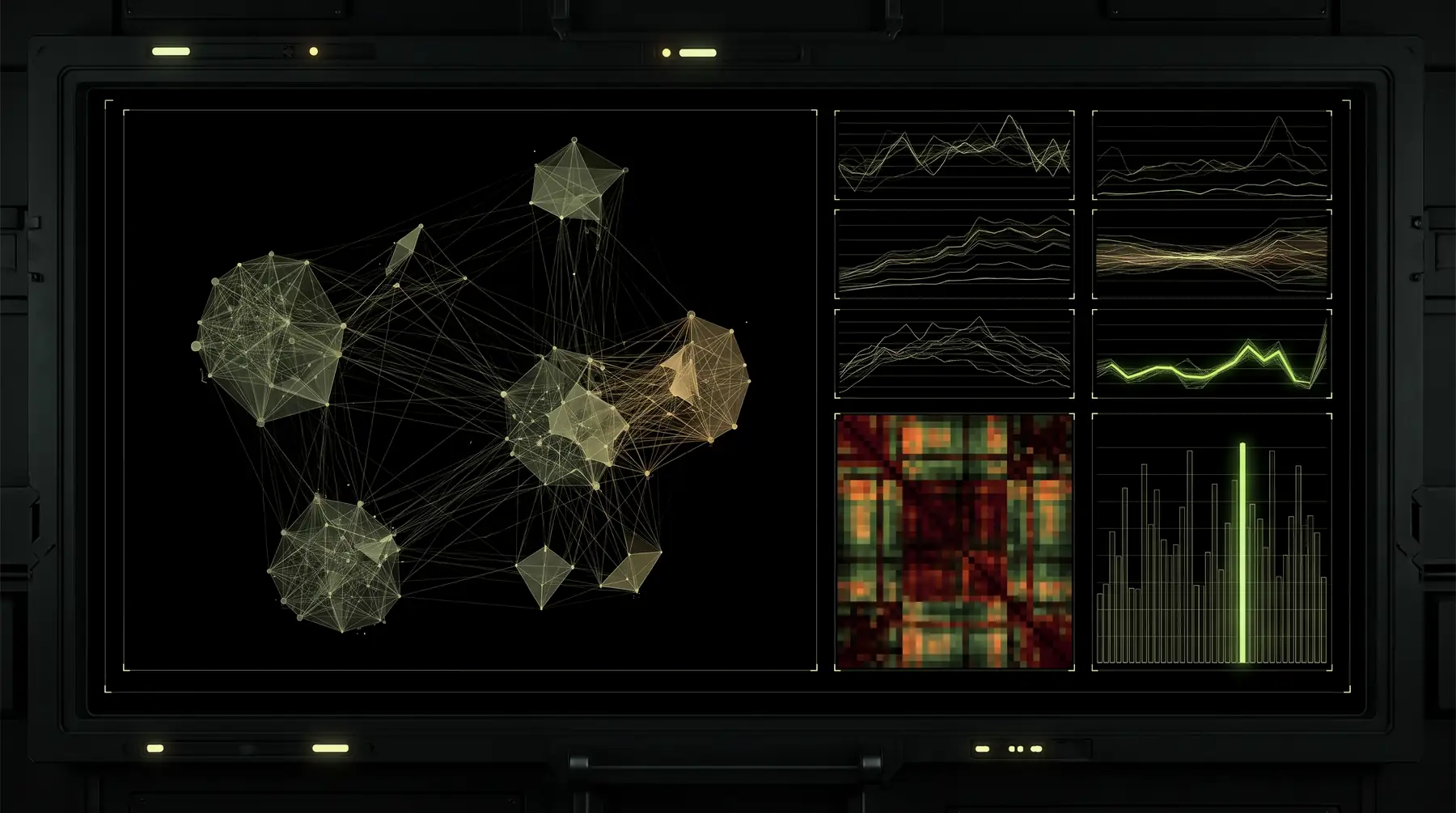
An analyst rarely needs one view. They need the network, the sequence and the geography at once, and today that is usually three tools and a spreadsheet. These are the five disciplines the library was shaped around. Each page is written in that discipline's language rather than ours — the problem as they state it, what the analyst needs to see, and which surfaces do it.
Five disciplines.
What an evaluator asks first.
You are new. Why should we bet on you?
Because the core is Apache-2.0 and cannot be taken away from you. If we disappear tomorrow, the code you shipped keeps working and you can fork it — a materially different risk profile from a closed SDK. Beyond that: we publish our test counts, our architecture, our roadmap and our limits, and you can read all of it before talking to us.
Do you have customers we can talk to?
Not yet, publicly. We are early and we will not invent references. What we will give you is a scoped evaluation, direct access to the engineers who built it, and founding-customer pricing locked for three years.
Really no dependencies?
Really none at runtime in the Community packages, and a build check fails if an import appears, transitive ones included. Build-time tooling — TypeScript, the test runner, the linter — does not ship. A database adapter uses the driver you already have; we do not bundle it.
How many nodes can it handle?
Roughly: SVG to about 2,000, Canvas to about 20,000, WebGL beyond 100,000. Above about 250,000 you should aggregate first, and we give you the clustering to do it. Exact figures depend on your hardware, your data and your styling.
What happens if you are acquired or shut down?
Community is Apache-2.0, permanently. Enterprise source is available in escrow. Neither can be revoked retroactively.
Is the free tier crippled?
No. Every chart type, layout, algorithm and renderer is in the free tier, with unlimited developers and unlimited applications. Paid tiers add collaboration, GPU acceleration, domain packs and support — not the ability to draw things.
The same two commitments, on every one of them.
One selection, not four
Click an entity in any surface and the others follow it, because the graph, the timeline, the map and the grid share a selection model. There is no synchronising code to write, because there is nothing to synchronise.
The demos are synthetic, and say so
Every dataset on this site is generated. A vendor demonstrating on real customer data is telling you something about how it will treat yours, and a vendor demonstrating on data it will not describe is telling you less than it appears to.